



DNA Ligase
DNA ligases are ATP-dependent enzymes that catalyze the formation of phosphodiester bonds between adjacent DNA termini and are essential for DNA replication, recombination, and DNA repair pathways that maintain genome stability[1][2]. During DNA replication, DNA ligase I (LIG1) functions as the primary ligase responsible for sealing Okazaki fragments on the lagging strand and is recruited to replication sites through interactions with proliferating cell nuclear antigen (PCNA)[1][3][4]. Beyond replication, LIG1 also participates in DNA repair processes, including long-patch base excision repair, thereby linking DNA synthesis and genome maintenance mechanisms[2][5]. Mechanistically, eukaryotic DNA ligases share a conserved catalytic core but differ in accessory domains that determine pathway specificity and protein interactions[2][6]. Compared with related isoforms, DNA ligase III (LIG3) is predominantly associated with single-strand break repair and exists as alternatively spliced isoforms, with LIG3α containing a BRCT domain that interacts with XRCC1 and a zinc-finger motif involved in DNA end recognition[1][2][5]. In contrast, DNA ligase IV (LIG4) functions in non-homologous end joining and is required for the repair of DNA double-strand breaks as well as V(D)J recombination through its interaction with XRCC4[2][7]. Defects in ligase-mediated DNA repair pathways can compromise genome integrity and contribute to disease-associated cellular phenotypes, including radiation sensitivity and immunological abnormalities linked to LIG4 deficiency[7]. For experimental applications, DNA ligases serve as central models for investigating DNA damage responses, replication-coupled repair, and pathway-specific genome maintenance mechanisms[2][6].
Verweise:
- [1]. Martin IV, et al. ATP-dependent DNA ligases. Genome Biol. 2002;3(4):REVIEWS3005. [Content Brief]
- [2]. Tomkinson AE, et al. DNA ligases: structure, reaction mechanism, and function. Chem Rev. 2006 Feb;106(2):687-99. [Content Brief]
- [3]. Montecucco A, et al. DNA ligase I is recruited to sites of DNA replication by an interaction with proliferating cell nuclear antigen: identification of a common targeting mechanism for the assembly of replication factories. EMBO J. 1998 Jul 1;17(13):3786-95. [Content Brief]
- [4]. Barnes K V, et al. Cloning of cardiac, kidney, and brain promoters of the feline ncx1 gene[J]. Journal of Biological Chemistry, 1997, 272(17): 11510-11517.
- [5]. Cotner-Gohara E, et al. Human DNA ligase III recognizes DNA ends by dynamic switching between two DNA-bound states. Biochemistry. 2010 Jul 27;49(29):6165-76. [Content Brief]
- [6]. Ellenberger T, et al. Eukaryotic DNA ligases: structural and functional insights. Annu Rev Biochem. 2008;77:313-38. [Content Brief]
- [7]. DNA Ligase gene information from NCBI.
All Product Categories
-
DNA Ligase Verwandte Produkte (11)
Verwandte Produkte (11)

- 1
-
SCR7 pyrazine
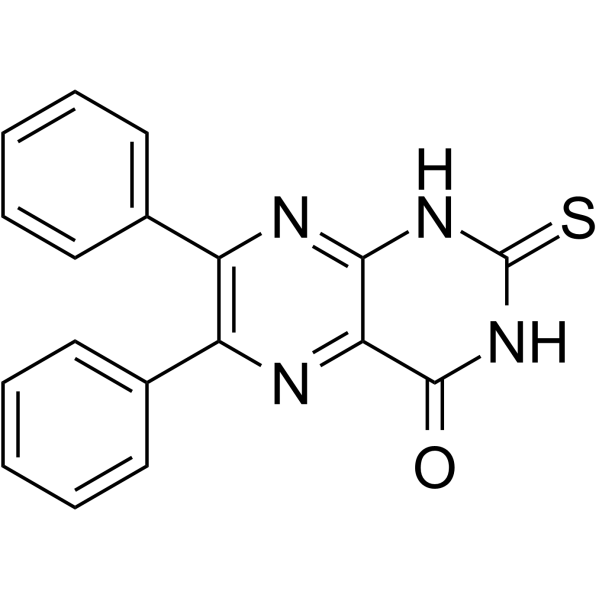 0 ImagesSCR7 pyrazine is a DNA ligase IV inhibitor that blocks nonhomologous end-joining (NHEJ) in a ligase IV-dependent manner. SCR7 pyrazine increases the efficiency of Cas9-mediated homology-directed repair (HDR). SCR7 pyrazine induces cell apoptosis and has anticancer activity.
-
L67
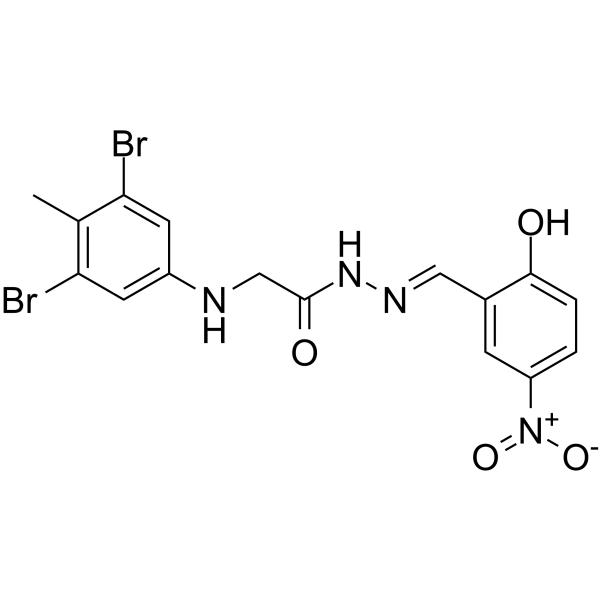 0 ImagesSynonyms: DNA Ligase InhibitorL67 (DNA Ligase Inhibitor) is a competitive DNA ligase inhibitor that effectively inhibits DNA ligases I/III (both IC50 are 10 μM). L67 can cause nuclear DNA damage by reducing levels of mitochondrial DNA and increasing levels of mitochondrially-generated ROS. L67 also activates the Caspase 1-dependent apoptosis pathway in cancer cells, can be used in cancer research.
-
L82
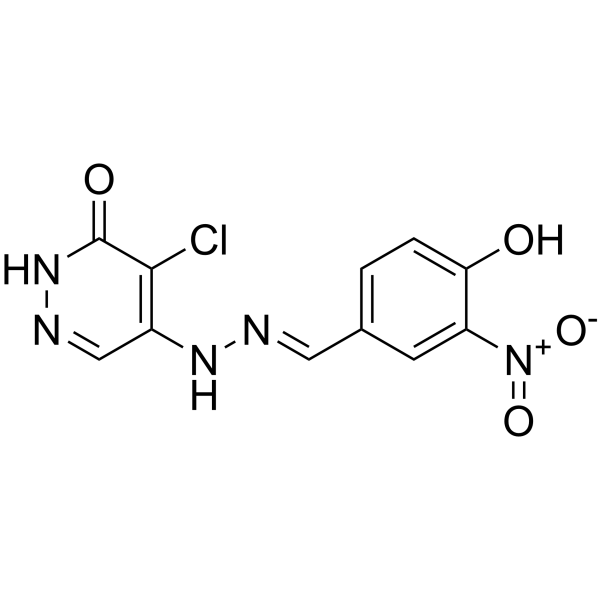 0 ImagesL82 is a selective and uncompetitive DNA ligase 1 (DNA Lig1) inhibitor (hLig1 IC50=12 μM). L82 shows anti-proliferative activity to breast cancer cells.
-
L82-G17
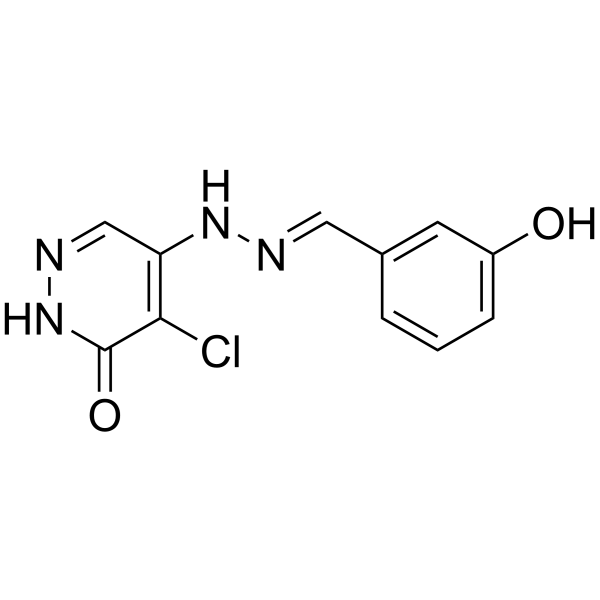 0 ImagesL82-G17 is an uncompetitive DNA ligase I (Lig I)-selective inhibitor. L82-G17 inhibits the third step of the ligation reaction, phosphodiester bond formation. L82-G17can be used as a probe of the catalytic activity.
-
L189
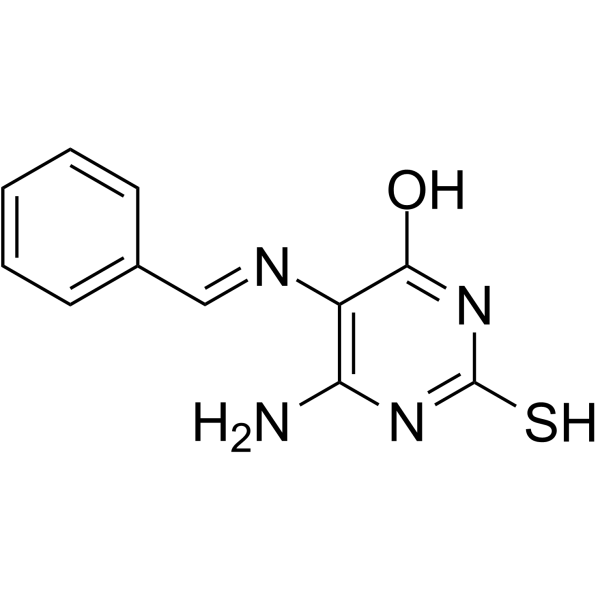 0 ImagesL189 is a DNA ligase inhibitor. L189 has inhibition effect for DNA Ligase I, III and IV with IC50 values of 5 μM, 9 μM and 5 μM, respectively. L189 has no cytotoxicity and individually increase cell death. L189 can be used for the research of cancer.
-
Bleomycin B2 sulfate
 0 ImagesSynonyms: Phleomycin D2 sulfateBleomycin B2 (Phleomycin D2) sulfate is a selective antitumor and antibacterial agent that induces DNA strand breaks and inhibits DNA ligase activity. The optimal pH for the activity of Bleomycin B2 sulfate is 9.1, and its efficacy is enhanced by thiol compounds or hydrogen peroxide. Bleomycin B2 sulfate undergoes enzymatic inactivation via bleomycin-inactivating enzymes, exhibits selective retention in squamous cell carcinoma, and is inactivated most rapidly in liver and kidney homogenates. Bleomycin B2 sulfate can be applied in research related to squamous cell carcinoma and other relevant studies.
-
DNA relaxation-IN-1
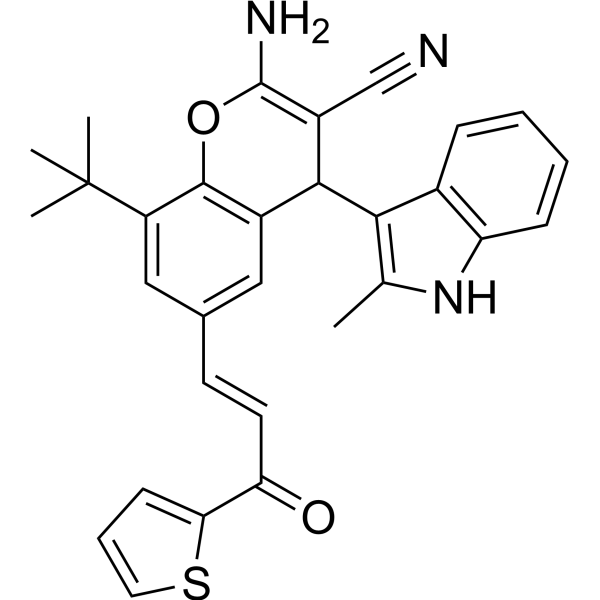 0 ImagesDNA relaxation-IN-1 (Compound 27) is a DNA ligase 1 DNA Lig1) inhibitor. DNA relaxation-IN-1 inhibits DNA ligation and disrupts the DNA relaxing activity of DNA Lig1. DNA relaxation-IN-1 induces Apoptosis. DNA relaxation-IN-1, in combination with Topotecan (HY-13768), exhibits synergistic antiproliferative effects against colorectal cancer.
-
T4 DNA ligase
 0 ImagesT4 DNA ligase is the product of gene 30 of phage T4. T4 DNA ligase catalyzes the repair of single-stranded nicks in duplex DNA and joins duplex DNA restriction fragments having either blunt or cohesive ends. T4 DNA ligase catalyze the sealing of adjacent 5′-phosphate and 3′-hydroxyl termini at single-stranded breaks in double-stranded DNA.T4 DNA ligase is an ATP-dependent ligase enzyme. T4 DNA ligase can be used in various biotechnological applications. T4 DNA ligase can join the ends of single-stranded DNA in the absence of any duplex DNA structure at the ligation site.
-
DNA ligase-IN-2
 0 ImagesArt. -Nr.: HY-150331CAS. Nr.: 635681-64-0DNA ligase-IN-2 (compound 2) is a potent LigA inhibitor and inhibits the DNA-independent autoadenylation activity of both full-length LigA and a truncated enzyme, LigA:AD (IC50=29 nM). DNA ligase-IN-2 effectively inhibits the growth of Staphylococcus aureus in vitro, with MIC valuse of 1, 1, and >64 μg/mL for S. aureus ATCC 29213, S. aureus ATCC 700699 and E. coli ATCC 25922, respectively.
-
E. coli DNA ligase
 0 ImagesArt. -Nr.: HY-E70604E. coli DNA ligase is a NAD+-dependent DNA ligase that catalyzes the formation of a phosphodiester bond between the complementary 3′-OH and 5′-P ends of dsDNA.
-
DNA ligase-IN-1
 0 ImagesArt. -Nr.: HY-150330CAS. Nr.: 68302-07-8DNA ligase-IN-1 (Compound 1) is an inhibitor of bacterial NAD+-dependent DNA ligase (LigA). DNA ligase-IN-1 effectively inhibits the growth of Staphylococcus aureus in vitro.
- 1



